
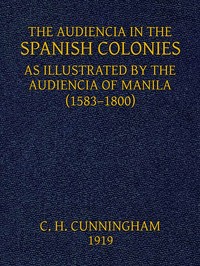
The Audiencia in the Spanish Colonies by Charles Henry Cunningham
Most of us picture the Spanish Empire with viceroys giving orders and treasure ships sailing home. 'The Audiencia in the Spanish Colonies' shows us what happened in between. It focuses on the high courts, called Audiencias, that were set up across the Americas and the Philippines. These weren't just courts for criminal cases; they were the central administrative hubs. The book explains how these bodies of judges and officials checked the power of the viceroys, managed local conflicts, and tried to enforce the king's laws from a distance that took months to communicate across.
Why You Should Read It
This isn't a dry list of laws. Cunningham brings the system to life by showing its constant tensions. You see the judges arguing with military governors, the crown's good intentions getting lost in translation, and how Indigenous groups sometimes used the court to their advantage. It reveals the empire as a constant negotiation, not a monolith. You get a real sense of the daily friction of ruling a continent.
Final Verdict
Perfect for history buffs who want to move beyond the simple conquest narrative and into the gritty reality of how an empire was managed day-to-day. If you've ever been curious about colonial administration, law, or the surprising ways power was actually distributed, this is a foundational and surprisingly engaging read. Just know it's a specialized academic work from the early 1900s, so it's more for the genuinely curious than someone looking for a light narrative.
This book is widely considered to be in the public domain. Thank you for supporting open literature.
Linda Miller
4 months agoWhile browsing through various academic sources, the critical analysis of current industry standards is very timely. It’s a comprehensive resource that doesn't feel bloated.
David Perez
2 months agoThis is now a staple reference in my professional collection.
David Garcia
9 months agoLooking at the bibliography alone, the language used is precise without being overly academic or confusing. It cleared up a lot of the confusion I had previously.
Robert White
1 year agoI found the author's tone to be very professional yet accessible, the quality of the diagrams and illustrations (if applicable) is top-notch. Truly a masterpiece of digital educational material.




Joseph Anderson
6 months agoHaving read the author's previous works, the historical context mentioned in the early chapters is quite enlightening. This adds significant depth to my understanding of the field.