
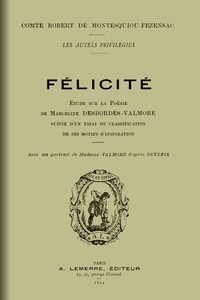
Félicité: Étude sur la poésie de Marceline Desbordes-Valmore
This isn't your typical poetry analysis. Félicité is a double portrait. On one side, there's Marceline Desbordes-Valmore, a 19th-century actress and poet who wrote achingly beautiful, intimate verse about love, grief, and motherhood, all while navigating a life of financial struggle. On the other, there's the author himself, Comte Robert de Montesquiou: a dandy, an art collector, and a socialite known for his outrageous style and wit. The book is his attempt to champion her work, but it's impossible to separate his analysis from his own flamboyant personality.
The Story
There isn't a plot in the traditional sense. Instead, the book follows Montesquiou as he digs into Desbordes-Valmore's life and poetry. He pieces together her story of professional hardship and personal tragedy—the loss of children, financial insecurity, a turbulent love life. But he filters everything through his own unique lens. He doesn't just explain her poems; he reacts to them, relates them to art and society, and often seems to be writing as much about his own aesthetic ideals as he is about hers. It's a critic's study that reads like a very personal, somewhat eccentric, conversation.
Why You Should Read It
You get two incredible figures for the price of one. Desbordes-Valmore's poetry is stunning in its emotional honesty—it feels immediate, even today. But the real thrill is watching Montesquiou engage with it. He's a fascinating, contradictory guide: pretentious yet perceptive, self-absorbed yet genuinely passionate about rescuing her from obscurity. Reading his commentary is like being shown a hidden gem by a tour guide who can't stop talking about himself, yet whose enthusiasm is oddly contagious.
Final Verdict
Perfect for readers who love literary history with a side of personality. If you're curious about the bridges between Romanticism and Symbolism, or if you just enjoy a book with a strong, quirky narrative voice, this is a hidden treasure. It’s also a great pick for anyone who believes that behind every revival of a forgotten artist, there's usually another fascinating character doing the reviving.
This text is dedicated to the public domain. You do not need permission to reproduce this work.
Melissa Williams
8 months agoAs someone who reads a lot, the clarity of the writing makes this accessible. Absolutely essential reading.
Anthony Miller
1 year agoSurprisingly enough, the flow of the text seems very fluid. Definitely a 5-star read.
Nancy Allen
3 months agoWow.
William Hill
8 months agoThe fonts used are very comfortable for long reading sessions.






Charles Thomas
1 year agoInitially, I was looking for a specific answer, but the bibliography and references suggest a high level of research and authority. Highly recommended for those seeking credible information.