
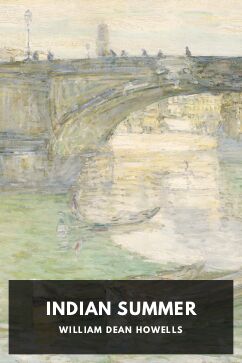
Indian Summer - William Dean Howells
William Dean Howells, often called the 'Dean of American Letters,' had a gift for writing about ordinary life with extraordinary clarity. Indian Summer, published in 1886, is a prime example. It’s a novel of manners, set against the romantic backdrop of Florence, Italy, but its real landscape is the complicated terrain of the human heart.
The Story
Theodore Colville is a forty-something newspaper editor from Indiana. He travels to Florence, a city full of memories from his youth, hoping to shake off a lingering sadness. There, he reconnects with an old acquaintance, Mrs. Lina Bowen, a charming and sensible widow, and is quickly drawn into her social circle. This includes her young charge, the beautiful and idealistic Imogene Graham.
What starts as a pleasant diversion turns into a tangle of emotions. Colville, despite his age and intentions, finds himself falling for the youthful Imogene. She, in turn, is swept up by the romance of the situation—an older, world-weary man and a chance to ‘save’ him. Meanwhile, Mrs. Bowen watches with growing concern and a quiet, unacknowledged affection of her own. The plot unfolds through conversations in drawing rooms, walks in gardens, and the immense weight of what is left unsaid. It’s a story about the conflict between youthful passion and mature love, between what society expects and what the heart wants.
Why You Should Read It
Don’t let the 19th-century setting fool you. The emotional confusion in this book feels timeless. Howells writes with a gentle, ironic humor that makes you wince in recognition. You’ll see yourself in these characters—in Colville’s mid-life uncertainty, in Imogene’s dramatic self-deception, and in Mrs. Bowen’s painful patience.
The genius of the book is its restraint. There are no villains, just people trying to do the right thing and making a mess of it. Howells doesn’t judge his characters; he observes them with a compassionate eye. Reading Indian Summer is like overhearing a fascinating, slightly scandalous conversation at the next café table. It’s a masterclass in social nuance and psychological realism.
Final Verdict
This book is perfect for readers who love classic literature but want something quieter than Dickens or more grounded than Austen. It’s for anyone who’s ever looked back on a life choice and wondered ‘what if?’ If you enjoy stories driven by complex characters and subtle social observations more than by wild plot twists, you’ll find a lot to love here. Think of it as a thoughtful, beautifully written pause—a perfect ‘Indian Summer’ of a novel to savor.
This book is widely considered to be in the public domain. Access is open to everyone around the world.
Michael Taylor
3 months agoIf you enjoy this genre, the plot twists are genuinely surprising. One of the best books I've read this year.
Kenneth Miller
4 months agoGreat reference material for my coursework.
Lisa Allen
3 months agoPerfect.
Robert Moore
1 year agoSurprisingly enough, it provides a comprehensive overview perfect for everyone. Truly inspiring.







Lucas Garcia
1 year agoBased on the summary, I decided to read it and the emotional weight of the story is balanced perfectly. I would gladly recommend this title.