L
Lisa Mays
Guest
- Thread Author
- #1
You watered on schedule, gave your monstera good light, and fed it last month, yet the new leaves are pale and small. So you add a little more fertilizer, just in case. A week later the leaf edges look scorched, and you're not sure whether the plant is hungry or overfed. That swing between too little and too much is exactly where a slow release fertilizer high in nitrogen can help, if you understand how it behaves in a warm pot.
Maya's fiddle leaf fig tells a familiar story. After a dose of fast, soluble food it pushed out bright leaves for two weeks, then stalled. She fed again, saw softer, floppier growth, and then watched lower leaves yellow. The plant wasn't asking for bigger meals. It needed smaller amounts available more often.
Nitrogen is the nutrient most closely tied to leaves and stems. It's part of chlorophyll, the pigment that makes foliage green, and part of the proteins a plant uses to build new cells. When nitrogen runs short, older leaves often pale first because the plant moves what nitrogen it has toward new growth. When nitrogen arrives all at once, roots sit in a strong solution, growth surges, and much of that feed can wash straight out at the next watering.
A slow release product changes the timing. Instead of dissolving in one event, pellets meter nitrogen out gradually, so the root zone sees a steadier supply between waterings. That design goal is old in agriculture. A field trial program reported in 2001 compared conventional urea with polyolefin coated urea in barley, potato, and corn, and in barley total nitrogen losses averaged 10% for conventional urea but only 1.9% for the controlled release treatment, an approximately 81% relative reduction.
Field soil isn't potting mix, so don't copy field rates into a container. The principle still travels well. You're trying to match supply to demand.
That last point matters. High nitrogen won't fix low light, root rot, or a pot that's mostly roots. It supports leafy growth when the basics are already working. Used at the right time and rate, it's a calmer way to feed foliage plants and young bonsai that you're trying to build up.
Picture a pellet as a tiny teabag, only the bag is a coating and the tea inside is a concentrated nitrogen core, often urea. Dry, it does almost nothing. When you water, moisture creeps through the coating, dissolves some of the core, and that solution diffuses back out into the mix. Dip, steep, sip. Repeat for weeks or months.
The visual below lays out that sequence from coating to steady release.
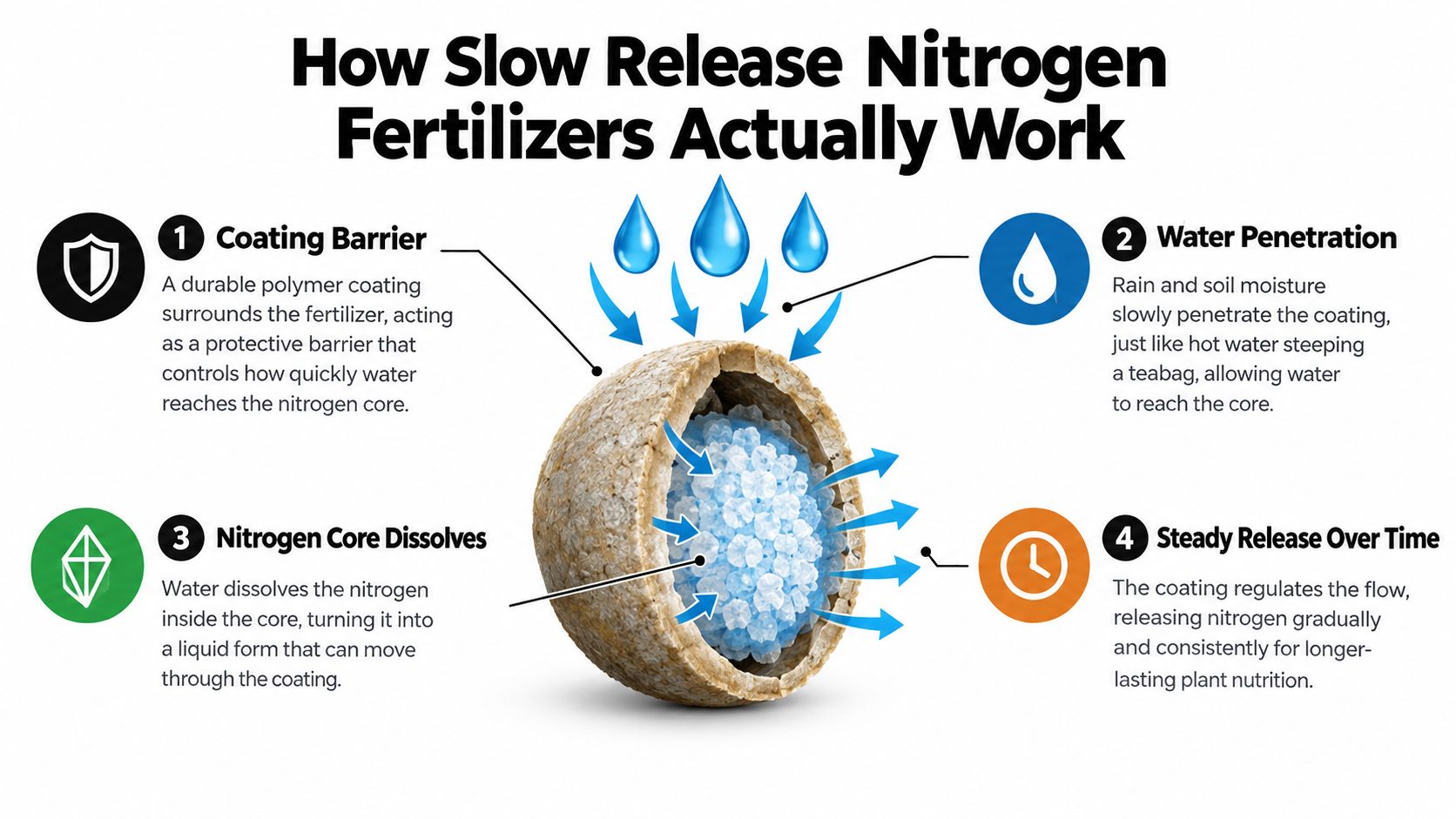
Coating thickness and material control the pace. A thicker or less permeable coat slows water entry, so two products with the same nitrogen percentage can empty on very different schedules. That's why judging by the first number on the bag alone misleads you. You're buying a release curve, not just a concentration.
Polymer coated urea delays water penetration and dissolution, and release is governed primarily by soil temperature and secondarily by moisture, with warmer, adequately moist soil accelerating diffusion while cool or dry conditions slow it down. In plain terms, warm mix steeps the teabag faster.
Labels often blur slow release and controlled release. Slow release is the broader, looser idea, nutrients become available gradually, sometimes through materials that break down unevenly. Controlled release usually means a coated product engineered for a more predictable pattern at a stated temperature. In a shop, read past the buzzword. Look for the stated longevity, the temperature it's based on, and whether the nitrogen source is coated.
Moisture is the supporting actor. Pellets left bone dry release little, then release more once watering resumes. Pellets kept constantly wet in a hot spot can move faster than you planned. Consistent, even moisture gives you the behavior the label had in mind.
One more confusion to clear up. Empty looking shells don't always mean you did something wrong. The coating can remain after the core has diffused out, so a leftover pellet skin isn't proof that feed is still inside. Check new growth and your calendar, adjusted for warmth, before you add more.
The three numbers on a bag are a recipe by weight, nitrogen, phosphorus, potassium, always in that order. An 18-6-8 product contains proportionally far more nitrogen than the other two. That first number is your foliage signal. A high first number tells you the formula is built to push leaves and stems first, with smaller support for roots, flowers, and stress tolerance from the other nutrients.
That doesn't make a bigger first number automatically better. Nitrogen encourages soft, leafy growth. Too much for the plant in front of you can mean leggy stems, delayed flowering, and foliage that looks lush but handles stress poorly. A young bonsai you're thickening and a mature bonsai you're refining want very different things from the same bag.
If the numbers still feel abstract, a plain guide to plant fertilizer numbers can help you compare ratios before you buy.
Read that release column with suspicion, in a good way. Duration isn't a permanent property of the pellet. It's an estimate tied to conditions, which is why the same 16-5-11 can behave differently on a cool shelf and a sunny balcony.
There's history behind these coatings. The modern controlled release nitrogen sector has roots in the 1960s, and sulfur coated urea, first commercialized in the United States, is described as the first widely adopted coated controlled release nitrogen product. Polymer coatings came later and widened the range of release patterns. So when you compare two bags, compare three things together, the ratio, the coating type if stated, and the intended release period. Nitrogen percentage alone can't tell you how your plant will experience that feed over a season.
Start with a simple question. Are you growing this plant mainly for its leaves right now? If the answer is yes, and it's actively growing, high nitrogen slow release often fits. If you're asking for flowers, fruit, or tight, refined form, slow down.
The diagram below groups the usual candidates and the plants that need a lighter hand.
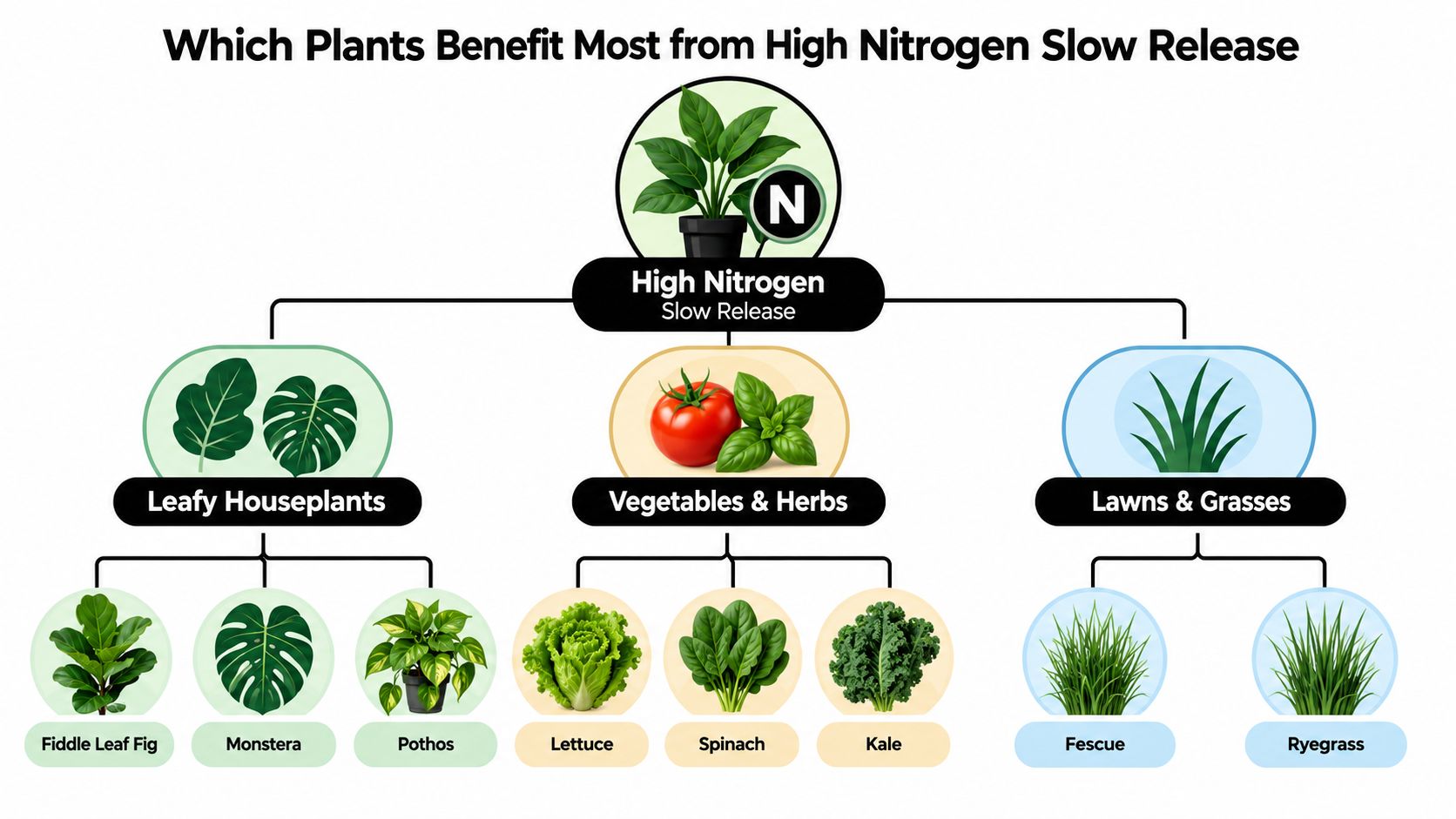
Leafy houseplants such as monstera, pothos, philodendron, and fiddle leaf fig use nitrogen to build the foliage you bought them for. Feed them when light is adequate and new leaves are forming. A plant sitting in a dark corner can't spend nitrogen well, so it'll sit in the mix instead.
Leafy vegetables and herbs grown for harvestable greens also lean nitrogen hungry during vegetative growth. Lettuce, spinach, kale, and basil fit that pattern better than a tomato you've shifted into flowering and fruiting mode.
Young bonsai in development are a special case. If you're building trunk and branch structure, stronger nitrogen during the growing season can support that work. Once you move to refinement, shorter internodes and compact pads matter more than raw vigor, so reduce the push.
Flowering houseplants and orchids don't need a foliage first diet when you're hoping for blooms. You may get leaves at the expense of flowers. Succulents and cacti are the clearest mismatch. They grow slowly, store water in their tissues, and generally want lean conditions. High nitrogen can produce weak, stretched growth, especially in low winter light.
Stage matters as much as species. A newly repotted plant, a drought stressed plant, or one entering dormancy shouldn't be pushed just because pellets are convenient. Wait until roots are working and growth has resumed. Think of nitrogen as an accelerator pedal. It's useful on an open road, unhelpful when the plant is parked.
Slow release is often sold as set and forget. That's the assumption to challenge. You still choose the dose, the placement, and the season, and in a small pot those choices are magnified because roots occupy a limited volume.
Use the process shown here as a sequence, measure the pot, follow the label rate for that container size, then time it to growth.
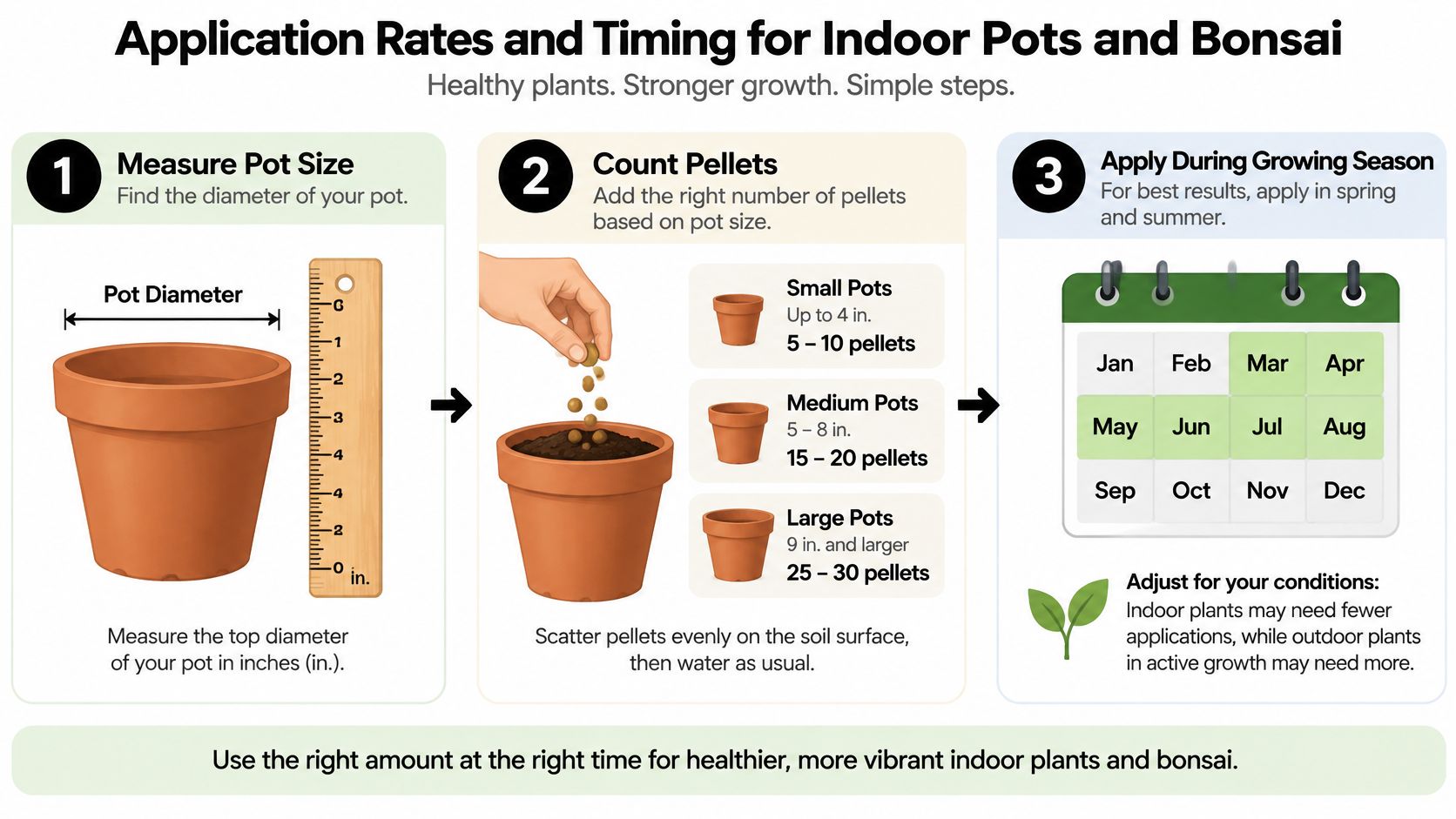
Start conservatively, especially with a new product or a shallow bonsai pot. Spread pellets evenly over the surface or incorporate them as the label directs, keeping them off the trunk and stems. Water afterward so the coating begins working in moist mix rather than sitting through irregular splashes. If you're unsure how label rates translate to your pot sizes, a walkthrough of fertilizer application rates will help you sanity check the math.
Timing follows the plant, not the calendar alone. Apply as active growth begins in spring or when indoor plants respond to longer, brighter days. Reapply only when the temperature adjusted window is ending and growth still justifies feeding. Ease off as growth slows in fall, and stop high nitrogen feeding during dormancy or when you're prioritizing flowers or compact bonsai form.
The reason timing beats quantity is mobility. Nitrogen can move below the root zone with irrigation, particularly in sandy or highly porous media, so soluble forms are more vulnerable to rapid depletion than controlled release forms. Pellets improve that timing, they don't create unlimited availability.
Watch this short demonstration before your first application, then compare what you see with your own pot size and placement.
Write the application date on a plant label. Future you won't remember whether those pellets went on six weeks ago or three months ago, and that note prevents the classic double dose.
A label that promises months of feeding is making an assumption about temperature, and your home may not match it. Release durations are commonly standardized around soil near 70°F, but the mix in an above ground pot doesn't behave like garden soil. Dark nursery pots in sun, shallow bonsai trays, greenhouse shelves, and warm windowsills can run considerably hotter.
The chart below shows why that gap matters for your feeding calendar.
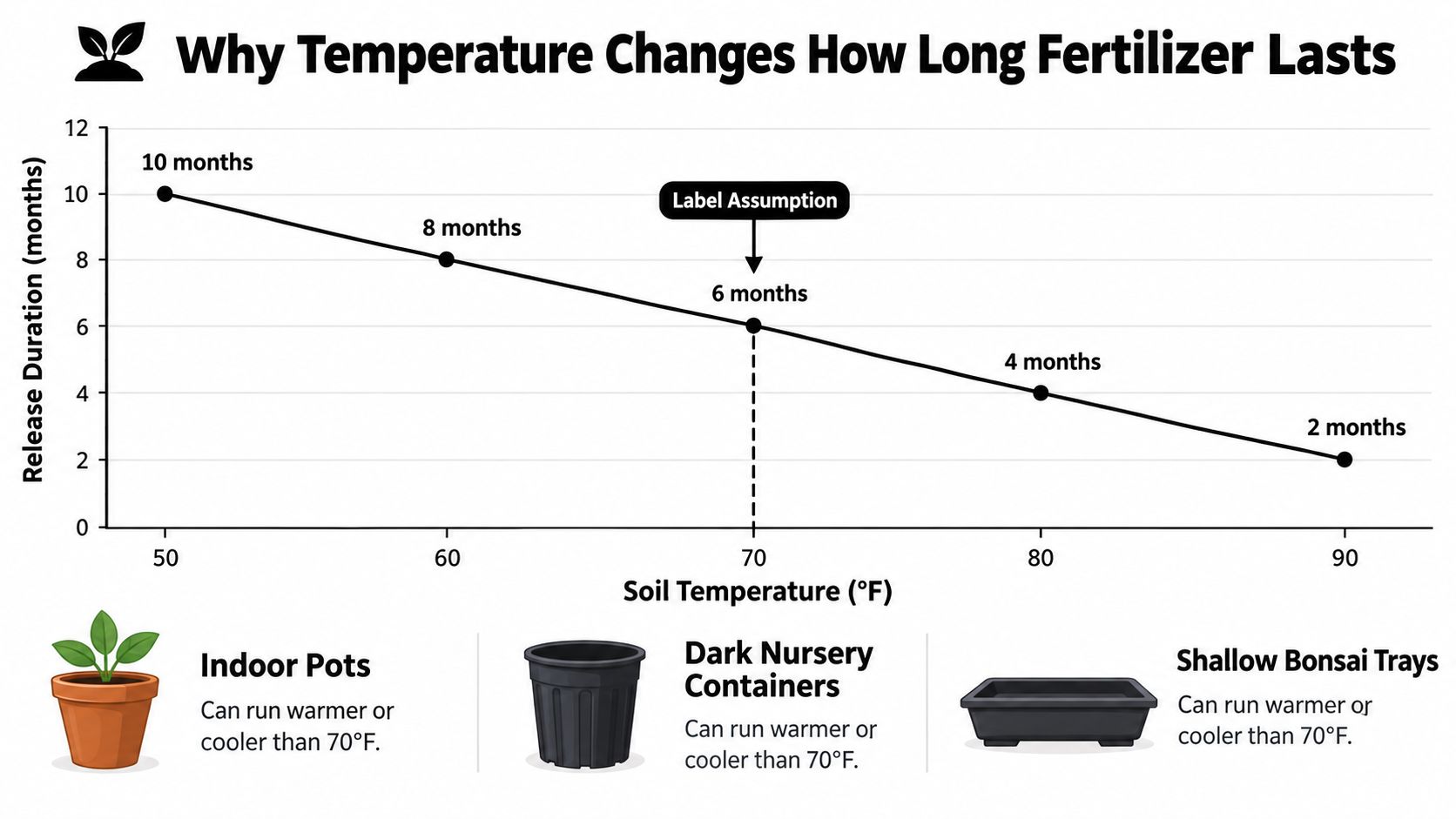
Iowa State University Extension reports a six month product may last only four to five months at 80°F and three to four months at 90°F, while cooler spring conditions can extend release time. Read that as a planning tool, not a guarantee for your exact brand. Your pellets may empty early during a hot, wet spell and linger during a cool one.
This is also why watering and heat interact. Frequent watering in a hot pot keeps coatings moist while temperature speeds diffusion, so release and drainage can both increase. If leaves pale early in midsummer, inspect before you assume. Roots may be crowded, light may have shifted, or pellets may still hold nitrogen that'll release with the next warm stretch. Adding more on top of residual feed is how a careful plan becomes an accidental overdose. Check the date you wrote down, estimate your average mix temperature, and only then decide.
A coated pellet forgives a lot. Dose, drainage, watering volume, media type, and temperature still decide whether nitrogen reaches roots, accumulates as salts, or drains out unused. In a warm container the margin narrows further, since release runs faster than the label's 70°F baseline assumes.
Learn the early warnings so you can act while they're small. Brown leaf edges, a white crust on the mix or pot rim, suddenly soft and leggy growth, and a plant that wilts despite moist mix all deserve a pause. None of these signs proves overfeeding on its own, since water quality and root problems can look similar, but together with a recent heavy application they're a strong clue. If you're sorting symptoms, this guide to the signs of over fertilizing plants can help you compare patterns before you change anything.
Once salts dissolve into the mix they behave like salt in a soup. You can't scoop them back out, only flush them through with generous watering.
The environmental side deserves the same honesty. University of Maryland Extension notes slow release products are less likely to leach than fast release ones, and reduced leaching still leaves some loss whenever drainage carries dissolved nitrogen out of the pot. Whatever exits the drainage holes ends up somewhere, so the cleanest fertilizer is the portion the plant absorbs.
Responsible feeding is restraint plus observation. Feed actively growing plants, use the lower end of the range when you're uncertain, and let the plant's response over several weeks guide the next application.
Pellets and liquids aren't rivals so much as different tools. Pellets give you a baseline. You apply them, they release with warmth and moisture, and you get breathing room between feeds. Liquids give you a dial. You can respond this week, skip next week, or dilute further for a sensitive plant, but you'll repeat the job often and each watering can carry unused nitrogen out of a porous mix.
Ask three questions before you choose. First, how predictable is your routine? If you travel or forget feeds, pellets forgive gaps. Second, how much control do you need? A bonsai you're refining, or an orchid approaching bloom, may suit small liquid doses you can stop instantly. Third, how warm is the pot? In a hot container, pellets may not be as hands off as the bag suggests.
Many growers combine them sensibly. Use a modest pellet dose as steady background nutrition during active leafy growth, then skip liquids unless the plant shows a clear need and conditions support growth. Don't layer a full liquid program on top of a full pellet program. That's two accelerators at once.
When you shop, read claims critically. Look for the NPK ratio, the nitrogen source or coating, the stated release period, and the temperature behind that period. One example of the pellet format is Leaves & Soul's 18-6-8 slow release bonsai fertilizer pellets, designed to release nutrients gradually. Compare any product, from any maker, against your plant's stage and your pot's temperature rather than chasing the highest first number.
Your final philosophy can stay simple. Feed leaves when the plant is building leaves, in good light, with working roots. Respect temperature, because it rewrites the label calendar. Water consistently, dose conservatively, and watch new growth for several weeks before you change course. A slow release fertilizer high in nitrogen works best when you treat it as timed nutrition, not as a shortcut around observation.
If you're ready to put a steadier feeding plan into practice, browse the slow release pellets, soils, and plant specific foods at Leaves & Soul and match a formula to your bonsai, fiddle leaf fig, or leafy houseplants. Start with a conservative dose, note your application date, and let your plant's next flush of growth tell you how well you timed it.
Why Your Plants Need a Slow Release Fertilizer High in Nitrogen
Maya's fiddle leaf fig tells a familiar story. After a dose of fast, soluble food it pushed out bright leaves for two weeks, then stalled. She fed again, saw softer, floppier growth, and then watched lower leaves yellow. The plant wasn't asking for bigger meals. It needed smaller amounts available more often.
Nitrogen is the nutrient most closely tied to leaves and stems. It's part of chlorophyll, the pigment that makes foliage green, and part of the proteins a plant uses to build new cells. When nitrogen runs short, older leaves often pale first because the plant moves what nitrogen it has toward new growth. When nitrogen arrives all at once, roots sit in a strong solution, growth surges, and much of that feed can wash straight out at the next watering.
A slow release product changes the timing. Instead of dissolving in one event, pellets meter nitrogen out gradually, so the root zone sees a steadier supply between waterings. That design goal is old in agriculture. A field trial program reported in 2001 compared conventional urea with polyolefin coated urea in barley, potato, and corn, and in barley total nitrogen losses averaged 10% for conventional urea but only 1.9% for the controlled release treatment, an approximately 81% relative reduction.
What steady feeding changes at home
Field soil isn't potting mix, so don't copy field rates into a container. The principle still travels well. You're trying to match supply to demand.
- Fewer feast and famine swings: Pellets keep releasing after the watering can is put away.
- Less guessing after a missed feed: A busy month doesn't leave a actively growing plant completely unfed.
- Lower surge risk: You're less likely to create one very salty watering, though dose still matters.
Think of it as a pantry trickle instead of a banquet. The plant still has to be growing, with enough light, to use what's served.
That last point matters. High nitrogen won't fix low light, root rot, or a pot that's mostly roots. It supports leafy growth when the basics are already working. Used at the right time and rate, it's a calmer way to feed foliage plants and young bonsai that you're trying to build up.
How Slow Release Nitrogen Fertilizers Actually Work
Picture a pellet as a tiny teabag, only the bag is a coating and the tea inside is a concentrated nitrogen core, often urea. Dry, it does almost nothing. When you water, moisture creeps through the coating, dissolves some of the core, and that solution diffuses back out into the mix. Dip, steep, sip. Repeat for weeks or months.
The visual below lays out that sequence from coating to steady release.
Coating thickness and material control the pace. A thicker or less permeable coat slows water entry, so two products with the same nitrogen percentage can empty on very different schedules. That's why judging by the first number on the bag alone misleads you. You're buying a release curve, not just a concentration.
Temperature does most of the steering
Polymer coated urea delays water penetration and dissolution, and release is governed primarily by soil temperature and secondarily by moisture, with warmer, adequately moist soil accelerating diffusion while cool or dry conditions slow it down. In plain terms, warm mix steeps the teabag faster.
Labels often blur slow release and controlled release. Slow release is the broader, looser idea, nutrients become available gradually, sometimes through materials that break down unevenly. Controlled release usually means a coated product engineered for a more predictable pattern at a stated temperature. In a shop, read past the buzzword. Look for the stated longevity, the temperature it's based on, and whether the nitrogen source is coated.
Moisture is the supporting actor. Pellets left bone dry release little, then release more once watering resumes. Pellets kept constantly wet in a hot spot can move faster than you planned. Consistent, even moisture gives you the behavior the label had in mind.
One more confusion to clear up. Empty looking shells don't always mean you did something wrong. The coating can remain after the core has diffused out, so a leftover pellet skin isn't proof that feed is still inside. Check new growth and your calendar, adjusted for warmth, before you add more.
Reading NPK Numbers on High Nitrogen Fertilizer Labels
The three numbers on a bag are a recipe by weight, nitrogen, phosphorus, potassium, always in that order. An 18-6-8 product contains proportionally far more nitrogen than the other two. That first number is your foliage signal. A high first number tells you the formula is built to push leaves and stems first, with smaller support for roots, flowers, and stress tolerance from the other nutrients.
That doesn't make a bigger first number automatically better. Nitrogen encourages soft, leafy growth. Too much for the plant in front of you can mean leggy stems, delayed flowering, and foliage that looks lush but handles stress poorly. A young bonsai you're thickening and a mature bonsai you're refining want very different things from the same bag.
If the numbers still feel abstract, a plain guide to plant fertilizer numbers can help you compare ratios before you buy.
Common High-Nitrogen Slow-Release Fertilizer Examples
| Product Type | NPK Ratio | Best For | Release Duration |
|---|---|---|---|
| Bonsai pellets | 18-6-8 | Young bonsai in active development | Per label at stated temperature |
| Houseplant pellets | 16-5-11 | Fiddle leaf fig and leafy houseplants | Per label at stated temperature |
| General coated urea | Varies | Leafy growth where label directs | Per label at stated temperature |
Read that release column with suspicion, in a good way. Duration isn't a permanent property of the pellet. It's an estimate tied to conditions, which is why the same 16-5-11 can behave differently on a cool shelf and a sunny balcony.
There's history behind these coatings. The modern controlled release nitrogen sector has roots in the 1960s, and sulfur coated urea, first commercialized in the United States, is described as the first widely adopted coated controlled release nitrogen product. Polymer coatings came later and widened the range of release patterns. So when you compare two bags, compare three things together, the ratio, the coating type if stated, and the intended release period. Nitrogen percentage alone can't tell you how your plant will experience that feed over a season.
Which Plants Benefit Most from High Nitrogen Slow Release
Start with a simple question. Are you growing this plant mainly for its leaves right now? If the answer is yes, and it's actively growing, high nitrogen slow release often fits. If you're asking for flowers, fruit, or tight, refined form, slow down.
The diagram below groups the usual candidates and the plants that need a lighter hand.
Good candidates when growth is active
Leafy houseplants such as monstera, pothos, philodendron, and fiddle leaf fig use nitrogen to build the foliage you bought them for. Feed them when light is adequate and new leaves are forming. A plant sitting in a dark corner can't spend nitrogen well, so it'll sit in the mix instead.
Leafy vegetables and herbs grown for harvestable greens also lean nitrogen hungry during vegetative growth. Lettuce, spinach, kale, and basil fit that pattern better than a tomato you've shifted into flowering and fruiting mode.
Young bonsai in development are a special case. If you're building trunk and branch structure, stronger nitrogen during the growing season can support that work. Once you move to refinement, shorter internodes and compact pads matter more than raw vigor, so reduce the push.
Plants to treat carefully
Flowering houseplants and orchids don't need a foliage first diet when you're hoping for blooms. You may get leaves at the expense of flowers. Succulents and cacti are the clearest mismatch. They grow slowly, store water in their tissues, and generally want lean conditions. High nitrogen can produce weak, stretched growth, especially in low winter light.
Stage matters as much as species. A newly repotted plant, a drought stressed plant, or one entering dormancy shouldn't be pushed just because pellets are convenient. Wait until roots are working and growth has resumed. Think of nitrogen as an accelerator pedal. It's useful on an open road, unhelpful when the plant is parked.
Application Rates and Timing for Indoor Pots and Bonsai
Slow release is often sold as set and forget. That's the assumption to challenge. You still choose the dose, the placement, and the season, and in a small pot those choices are magnified because roots occupy a limited volume.
Use the process shown here as a sequence, measure the pot, follow the label rate for that container size, then time it to growth.
Start conservatively, especially with a new product or a shallow bonsai pot. Spread pellets evenly over the surface or incorporate them as the label directs, keeping them off the trunk and stems. Water afterward so the coating begins working in moist mix rather than sitting through irregular splashes. If you're unsure how label rates translate to your pot sizes, a walkthrough of fertilizer application rates will help you sanity check the math.
Timing follows the plant, not the calendar alone. Apply as active growth begins in spring or when indoor plants respond to longer, brighter days. Reapply only when the temperature adjusted window is ending and growth still justifies feeding. Ease off as growth slows in fall, and stop high nitrogen feeding during dormancy or when you're prioritizing flowers or compact bonsai form.
The reason timing beats quantity is mobility. Nitrogen can move below the root zone with irrigation, particularly in sandy or highly porous media, so soluble forms are more vulnerable to rapid depletion than controlled release forms. Pellets improve that timing, they don't create unlimited availability.
Watch this short demonstration before your first application, then compare what you see with your own pot size and placement.
Write the application date on a plant label. Future you won't remember whether those pellets went on six weeks ago or three months ago, and that note prevents the classic double dose.
Why Temperature Changes How Long Fertilizer Lasts
A label that promises months of feeding is making an assumption about temperature, and your home may not match it. Release durations are commonly standardized around soil near 70°F, but the mix in an above ground pot doesn't behave like garden soil. Dark nursery pots in sun, shallow bonsai trays, greenhouse shelves, and warm windowsills can run considerably hotter.
The chart below shows why that gap matters for your feeding calendar.
Iowa State University Extension reports a six month product may last only four to five months at 80°F and three to four months at 90°F, while cooler spring conditions can extend release time. Read that as a planning tool, not a guarantee for your exact brand. Your pellets may empty early during a hot, wet spell and linger during a cool one.
Build a temperature adjusted calendar
- Warm spot, sunny balcony or dark pot: Check growth and color well before the label end date.
- Average indoor shelf: Use the label window as a rough guide, then confirm with new growth.
- Cool spring room: Expect slower release and don't stack a second dose just because results look quiet.
Warmer conditions can turn a gentle program into a faster, stronger one. The pellet didn't change. Your pot's temperature did.
This is also why watering and heat interact. Frequent watering in a hot pot keeps coatings moist while temperature speeds diffusion, so release and drainage can both increase. If leaves pale early in midsummer, inspect before you assume. Roots may be crowded, light may have shifted, or pellets may still hold nitrogen that'll release with the next warm stretch. Adding more on top of residual feed is how a careful plan becomes an accidental overdose. Check the date you wrote down, estimate your average mix temperature, and only then decide.
Preventing Overfeeding and Nutrient Loss
A coated pellet forgives a lot. Dose, drainage, watering volume, media type, and temperature still decide whether nitrogen reaches roots, accumulates as salts, or drains out unused. In a warm container the margin narrows further, since release runs faster than the label's 70°F baseline assumes.
Learn the early warnings so you can act while they're small. Brown leaf edges, a white crust on the mix or pot rim, suddenly soft and leggy growth, and a plant that wilts despite moist mix all deserve a pause. None of these signs proves overfeeding on its own, since water quality and root problems can look similar, but together with a recent heavy application they're a strong clue. If you're sorting symptoms, this guide to the signs of over fertilizing plants can help you compare patterns before you change anything.
A practical prevention checklist
- Dose for the pot you have: Follow the label for container volume, and start low with bonsai and newly repotted plants.
- Water evenly, not excessively: Keep mix consistently moist for plants that want it, and let excess drain rather than sit in a saucer.
- Place pellets as directed: Don't pile them against stems, and don't crush coated pellets to speed them up.
- Flush when salts build: Water thoroughly so solution exits the drainage holes, then discard what collects below.
- Stop when growth stops: Dormant, drought stressed, or low light plants can't use a high nitrogen supply well.
Once salts dissolve into the mix they behave like salt in a soup. You can't scoop them back out, only flush them through with generous watering.
The environmental side deserves the same honesty. University of Maryland Extension notes slow release products are less likely to leach than fast release ones, and reduced leaching still leaves some loss whenever drainage carries dissolved nitrogen out of the pot. Whatever exits the drainage holes ends up somewhere, so the cleanest fertilizer is the portion the plant absorbs.
Responsible feeding is restraint plus observation. Feed actively growing plants, use the lower end of the range when you're uncertain, and let the plant's response over several weeks guide the next application.
Choosing Between Slow Release Pellets and Liquid Fertilizers
Pellets and liquids aren't rivals so much as different tools. Pellets give you a baseline. You apply them, they release with warmth and moisture, and you get breathing room between feeds. Liquids give you a dial. You can respond this week, skip next week, or dilute further for a sensitive plant, but you'll repeat the job often and each watering can carry unused nitrogen out of a porous mix.
Ask three questions before you choose. First, how predictable is your routine? If you travel or forget feeds, pellets forgive gaps. Second, how much control do you need? A bonsai you're refining, or an orchid approaching bloom, may suit small liquid doses you can stop instantly. Third, how warm is the pot? In a hot container, pellets may not be as hands off as the bag suggests.
Many growers combine them sensibly. Use a modest pellet dose as steady background nutrition during active leafy growth, then skip liquids unless the plant shows a clear need and conditions support growth. Don't layer a full liquid program on top of a full pellet program. That's two accelerators at once.
When you shop, read claims critically. Look for the NPK ratio, the nitrogen source or coating, the stated release period, and the temperature behind that period. One example of the pellet format is Leaves & Soul's 18-6-8 slow release bonsai fertilizer pellets, designed to release nutrients gradually. Compare any product, from any maker, against your plant's stage and your pot's temperature rather than chasing the highest first number.
Your final philosophy can stay simple. Feed leaves when the plant is building leaves, in good light, with working roots. Respect temperature, because it rewrites the label calendar. Water consistently, dose conservatively, and watch new growth for several weeks before you change course. A slow release fertilizer high in nitrogen works best when you treat it as timed nutrition, not as a shortcut around observation.
If you're ready to put a steadier feeding plan into practice, browse the slow release pellets, soils, and plant specific foods at Leaves & Soul and match a formula to your bonsai, fiddle leaf fig, or leafy houseplants. Start with a conservative dose, note your application date, and let your plant's next flush of growth tell you how well you timed it.