
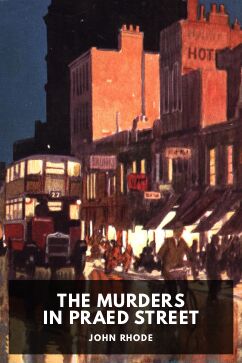
The Murders in Praed Street - John Rhode
John Rhode's The Murders in Praed Street is a classic locked-room mystery from 1928 that feels both comfortably familiar and cleverly fresh. It's a story built on a simple, chilling premise: how can murder happen in a sealed space?
The Story
The setting is a typical London boarding house run by the stern Mrs. Gabb. One evening, her boarders hear a crash from her private sitting room. They find the door locked. When they break it down, they discover Mrs. Gabb dead on the floor. The window is shut and latched, the fireplace is blocked, and there's no sign of a weapon or how the killer escaped. The police are baffled. Just as the investigation stalls, a second person in the same house is killed in an eerily similar way, behind another locked door. Enter Dr. Lancelot Priestley, an eccentric retired mathematician. He isn't a detective, but he has a brilliant mind for logic and facts. While the police chase motives and alibis, Priestley focuses on the physical puzzle of the rooms themselves, convinced the answer lies in the mechanics of the crime.
Why You Should Read It
This isn't a thriller full of chases and drama. The pleasure here is pure puzzle-solving. Rhode plays completely fair with the reader. Every clue is presented; you just have to put them together like Dr. Priestley does. I loved how the story shifts your focus from the 'usual suspects' among the boarders to the very architecture of the crime scene. Priestley himself is a great character—he's irritable, obsessed with logic, and wonderfully dismissive of theories that don't fit the facts. The book is a masterclass in the 'howdunit,' making something as ordinary as a room feel sinister and full of secrets.
Final Verdict
This book is perfect for fans of Agatha Christie's Poirot puzzles or anyone who misses the golden age of detective fiction where brains beat brawn. If you enjoy sitting with a book and a cup of tea, mentally testing solutions against the clues, you'll have a blast. It's not heavy on character depth or social commentary; it's a clever, satisfying logic game wrapped in a 1920s London atmosphere. A truly enjoyable escape for the armchair detective in all of us.
This publication is available for unrestricted use. It is available for public use and education.
Charles Martinez
2 years agoMy first impression was quite positive because the logic behind each conclusion is easy to follow and verify. A trustworthy resource that I'll keep in my digital library.
Karen Wilson
6 months agoHaving explored several resources on this, I find that the way it challenges the status quo is both daring and well-supported. This has become my go-to guide for this specific topic.
James Moore
4 months agoThe balance between academic rigor and readability is perfect.
Margaret Moore
1 month agoA sophisticated analysis that fills a gap in the literature.
Matthew Garcia
1 year agoThe digital formatting makes it very easy to navigate.