
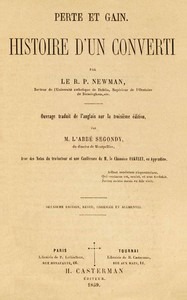
Perte et gain : histoire d'un converti by John Henry Newman
Perte et gain : histoire d'un converti (Loss and Gain: The Story of a Convert) is Newman's first major work after his conversion, published in 1848. It's part novel, part spiritual memoir, written to explain a decision that shocked Victorian England.
The Story
The book follows a young Oxford student named Charles Reding. He's not a rebel; he's a thoughtful, sincere guy trying to figure out what he truly believes. As he moves through university life—friendships, debates, sermons—his certainty in the Anglican faith begins to crack. We watch him wrestle with history, doctrine, and his own conscience. The real tension isn't in dramatic events, but in the quiet, relentless pressure of his thoughts. The "loss" is everything he leaves behind: his position, his community, his expected future. The "gain" is a hard-won, solitary peace of mind.
Why You Should Read It
I was hooked by how modern Newman's inner conflict feels. This isn't about angels or visions; it's about a smart person doing deep research, feeling isolated, and facing serious social consequences for his choice. You feel the weight of his loneliness and the courage of his conviction. It completely dismantles the idea that religious conversion is a simple leap of blind faith. For Newman, it was a painfully slow, logical conclusion.
Final Verdict
Perfect for anyone interested in intellectual history, spiritual journeys, or just a great character study. You don't need to be religious to appreciate it. At its heart, it's for anyone who has ever had to choose between fitting in and being true to themselves. It's a slow, thoughtful read, not a page-turner, but it sticks with you. Think of it as the 19th-century blog post of a man explaining his most controversial life decision to a confused and critical public.
This book is widely considered to be in the public domain. Thank you for supporting open literature.
Robert Davis
1 year agoFinally found time to read this!
Lisa Lee
1 year agoA bit long but worth it.
Karen Williams
7 months agoUsed this for my thesis, incredibly useful.
Deborah Brown
1 year agoGreat reference material for my coursework.

Lisa King
1 year agoWithout a doubt, it provides a comprehensive overview perfect for everyone. Exceeded all my expectations.