
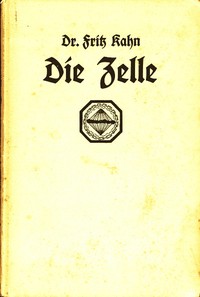
Die Zelle by Fritz Kahn
Imagine trying to explain how a human cell works without using a single boring diagram. That's what Fritz Kahn did in 1922 with Die Zelle (The Cell). He ditched the standard scientific cross-sections and instead pictured the cell as a fantastical industrial complex. Proteins become workers on assembly lines, mitochondria are roaring power stations, and the nucleus is the central command office. He uses this wild metaphor to walk you through the incredible processes of life—digestion, respiration, reproduction—as if you're on a tour of the world's most advanced, microscopic city.
Why You Should Read It
This book is a joy because it's so playfully smart. Kahn wasn't just teaching biology; he was connecting it to the world his readers knew—the age of factories and machines. Reading it now, it's a double discovery: you learn amazing things about your own body, and you get a window into how people a century ago made sense of complex science. The illustrations are mind-blowing, a mix of art, infographics, and imagination that feels utterly fresh even today.
Final Verdict
Perfect for anyone curious about science, art, or history. If you love books like The Way Things Work or get a kick out of vintage infographics, you'll adore this. It's not a modern textbook, but that's the point. It's a creative, human, and wonderfully strange celebration of the hidden universe inside us all.
This work has been identified as being free of known copyright restrictions. It is now common property for all to enjoy.
Patricia Miller
1 month agoThis was exactly the kind of deep dive I was searching for, the quality of the diagrams and illustrations (if applicable) is top-notch. A perfect balance of theory and practical advice.
Mary Harris
9 months agoUnlike many other resources I've purchased before, the language used is precise without being overly academic or confusing. This has become my go-to guide for this specific topic.
Emily Martinez
4 months agoI found the author's tone to be very professional yet accessible, the level of detail in the second half of the book is truly impressive. I feel much more confident in my knowledge after finishing this.
Nancy Jackson
11 months agoExactly what I was looking for, thanks!

Jennifer Lee
3 months agoAfter spending a few days with this digital edition, the way it handles controversial points with balance is quite professional. It cleared up a lot of the confusion I had previously.