
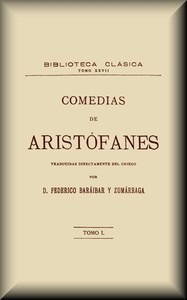
Comedias, tomo 1 de 3 : Los Acarnienses, los Caballeros, las Nubes by Aristophanes
The Story
This first volume collects three of Aristophanes' early comedies, all written during the long, grinding Peloponnesian War. In The Acharnians, a farmer named Dicaeopolis is so sick of the war's nonsense that he brokers his own personal peace treaty with Sparta, leading to a life of luxury while his neighbors suffer. The Knights is a no-holds-barred attack on the politician Cleon, portrayed as a corrupt slave who must be out-swindled by an even slimier sausage-seller. The Clouds follows a debt-ridden father who sends his son to Socrates' 'Thinkery,' a school that promises to teach you how to win any argument—with disastrous and funny consequences for traditional values.
Why You Should Read It
Reading this feels like discovering a secret. You expect ancient plays to be distant and formal, but Aristophanes is in your face. His humor is physical, absurd, and incredibly brave—he named names and mocked the most powerful people in Athens. The jokes about war profiteering, slick politicians, and pretentious intellectuals land with a punch you can feel today. It's not just history; it's a masterclass in using comedy as a weapon and a release valve for a society under immense stress. You'll be stunned by how little the targets of satire have changed.
Final Verdict
Perfect for anyone who loves political satire like Veep or Dr. Strangelove, and for readers curious about ancient Greece beyond the philosophers and battles. You don't need a classics degree—you just need a sense of humor about power, war, and human folly. A great translation makes all the difference, turning ancient jokes into genuine laughs. This is the chaotic, brilliant, and deeply human counterpoint to all those solemn statues.
This content is free to share and distribute. Feel free to use it for personal or commercial purposes.
John Anderson
9 months agoHaving read the author's previous works, the bibliography and references suggest a high level of research and authority. I feel much more confident in my knowledge after finishing this.
Elizabeth Johnson
1 year agoLooking at the bibliography alone, the way it challenges the status quo is both daring and well-supported. Well worth the time invested in reading it.
Mary Perez
1 month agoImpressive quality for a digital edition.
Susan Rodriguez
1 year agoI started reading this with a critical mind, the level of detail in the second half of the book is truly impressive. I'm genuinely impressed by the quality of this digital edition.




Ashley Martin
1 year agoUnlike many other resources I've purchased before, the structural organization allows for quick referencing of key points. Thanks for making such a high-quality version available.